Preparing your home for overnight guests can feel like a chore. But whether your guests are staying for one night or several nights, you will want them to sleep comfortably. Here’s what you need to consider.
How will the room be used?
One of the first things to decide is how you will use the room. Whether it’s a dedicated guest bedroom, a multifunctional space, or a home office, some initial planning is necessary to ensure a comfortable environment for your visitors.
Who will be using the bed?
In addition to the room’s purpose, consider your guests’ requirements. Children, for example, are often more adaptable and can usually sleep on anything. However, adults, especially those with back pain, may require a more comfortable and supportive mattress.
How much should you spend on a guest bed?
How much you spend on a guest bed depends on several factors, such as your budget, who will be using the bed and how frequently you have visitors. For instance, if adults use the bed fairly often, you may want to spend more than if children use it now and again.
There may also be occasions where you may have to use the bed. For example, if you’re decorating the main bedroom or your partner is ill.
What types of beds are available for guest rooms?
It’s usually a good idea to replace the bed base at the same time as the mattress, especially if it’s several years old. Keeping an old bed base is unlikely to provide the mattress with the necessary support. If it’s dipping in areas, the new mattress will follow its shape. Consider the comfort of your guests. The last thing they want is to sleep on an old, squeaky bed that’s falling apart.
Divan beds
Divan beds are a popular option for spare rooms because the base tends to be the same size as the mattress it is paired with. Most divans are available in various materials. Some also come with a matching headboard for a coordinated look.
The most luxurious divans feature a sprung unit mounted on the frame. Sprung divans improve comfort and can help extend the life of the mattress. In contrast, solid or platform top divans are often made from hardboard and are generally cheaper.
Divan beds offer versatile storage solutions. Some feature drawers underneath, providing extra storage space for bedding, books, and other bedroom items. Alternatively, divan ottoman beds have a hinged top that lifts to reveal a large hidden storage area for your belongings.
Bed frames
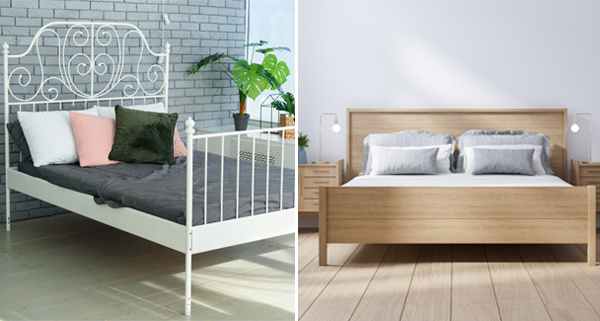
Bed frames are available in wood, metal, fabric, and leather to complement any room décor. They typically occupy more room space than divans because the mattress often sits inside the frame.
Trundle beds
A trundle bed is a clever space-saving solution that consists of a main bed with another bed stored underneath it. The underbed is referred to as the trundle. It usually has wheels or castors so that it can easily be rolled out or pushed underneath the main bed.
The underbed can often be raised to the same height as the main bed, allowing the beds to be pushed together for couples or kept apart as twin beds.
Trundle beds often come with thinner mattresses so that one bed can easily fit underneath the other. These mattresses typically have less cushioning and may not feel as comfortable as regular mattresses.
Also, be mindful that the underbed is sometimes smaller than the main bed. So, it may not be suitable for an adult.
Sofa beds
A sofa bed is a couch that converts into an occasional bed. It is a versatile option for multipurpose rooms as it provides comfortable seating during the day for work or lounging and an additional bed for sleeping.
The bed is cleverly stored inside the sofa when not in use, taking up less room space than a traditional double bed that always occupies the same area.
Sofa bed mattresses tend to be relatively shallow, so they can be easily folded or stored within the sofa. They typically have less cushioning than regular mattresses and may not feel as comfortable.
Another drawback with sofa beds is their weight and the challenge of moving them. This can make getting a sofa bed upstairs into a guest room difficult. While it’s possible to remove the sofa bed mechanism to make it lighter and easier to handle, it’s wise to carefully measure your property and discuss any concerns with the retailer before ordering to prevent delivery issues.
Otherwise, you could always use the sofa bed for your living room. Just remember to choose one with comfortable seating designed for everyday use.
Day beds
Like a sofa bed, you can use a day bed for lounging and sleeping. Day beds typically consist of a frame with a backrest and two sides. They also have a large cushion or mattress for comfortable seating and sleeping.
Day beds are available in various materials, such as wood, metal, wicker, and fabric, in styles to suit traditional and modern settings. Some daybeds come with an additional trundle bed that can be pulled out from underneath the daybed to provide extra sleeping space when required.
Folding guest beds
A folding bed, also referred to as a z-bed, is a portable bed that can be neatly folded and stored when not in use. Folding beds typically consist of a metal frame and often have wheels or castors so that they can be easily moved.
Folding beds come in handy in properties with limited space that require an extra bed when needed. However, while folding beds are convenient for occasional use, the mattresses are thinner so that they can be folded and may not feel as comfortable as traditional mattresses.
Air beds
An air mattress or blow-up bed is an inflatable mattress made from materials like PVC, rubber and plastic. These mattresses are easy to store and inflate.
What size bed is suitable for a guest room?
The size of the bed you choose depends on how much room space you have available and how many guests you anticipate hosting. While a single bed may suffice for a single person sleeping alone, accommodating couples requires more consideration.
Start by assessing the available room space. Larger beds occupy more floor space, so ensure the room can accommodate a bigger size, like a king or super king. There should also be enough room to walk around the bed once it’s in place.
Also, consider guest comfort. Couples typically sleep better in bigger beds. In general, you should choose a bed as big as the room allows. However, larger beds are typically more expensive. So, it helps to balance your budget against other factors, like comfort and guest frequency.
If the room has other uses, like a home office or gym, consider how the bed size might affect those activities.
Common bed sizes for guest rooms include:
Single beds
Single beds work well in smaller guest rooms and are ideal for children or a single adult. They are not ideal for couples because of the limited sleeping space.
A mistake that some people make with single beds is converting it into a daybed for everyday lounging. While this may seem like a cost-effective solution to convert the guest room into a multifunctional space, sitting on the edge of the bed for prolonged periods puts pressure on the components and can weaken the edge of the bed, so it should be avoided.
Twin beds are a popular option for larger rooms, allowing you to have two single beds in one room. These beds can be kept apart or pushed together when used by couples.
Three quarter beds
Three quarter beds have become popular, particularly in modern homes with smaller bedrooms. These beds are wider than a single bed but smaller than a standard double bed. They are ideal for a single person looking for extra sleeping space. They can also be used occasionally by couples who don’t mind cosying up together.
Three quarter beds also work well in properties with access restrictions, such as a narrow staircase, where a larger bed won’t fit up the stairs and into the room.
Standard double beds
Most people in the UK sleep in a standard double bed. A double can feel quite spacious for a single person but may feel somewhat cosy for couples. Nevertheless, they make a suitable choice for guest rooms when space is limited and you need an affordable option to accommodate couples.
King size beds
A king size bed is a more spacious option for larger guest bedrooms. They allow couples to sleep more comfortably by providing slightly more sleeping space. King size beds are also longer than singles and doubles, making them ideal for taller individuals.
It usually doesn’t cost much more to upgrade from a standard double bed to a king. Some manufacturers may even offer a free upgrade option, allowing you to purchase the king size model for the same price as the standard double.
Mattresses are often available in soft, medium, firm and sometimes extra firm spring tensions catering to different body weights and preferences. Some mattresses can have split tensions, allowing sleeping partners to choose their preferred firmness level on their side of the bed. This can be beneficial for couples of significantly different weights. While a split-tension mattress can be useful for regular guests like family members, it may not suit all guests.
Super king size beds
A super king size bed is perfect for couples who value sleeping space. There’s ample room for stretching out, and sleeping partners are less likely to disrupt each other during the night.
However, be aware that super king size mattresses are notably heavier, making turning and moving them more challenging. You must also check if a super king size bed can fit into the intended room by measuring doors, stairs and walkways to avoid delivery issues.
Zip and link beds
Zip and link beds offer a flexible sleeping solution, allowing two beds to be combined into a larger one. Unlike twin beds, which may separate when pushed together, zip and link mattresses are securely zipped and have clipping bars to keep the bed bases together.
Zip and link beds are typically more expensive than standard beds. They also measure 200 cm long (6’6”), making them longer than standard single beds at 190 cm (6’3”) long. As a result, special-sized bedding may be necessary when using them as separate single beds.
Despite these considerations, zip and link beds are versatile and flexible, making them suitable for many households.
What type of mattresses should be considered for guest rooms?
Choosing a suitable mattress for a guest bedroom can be challenging, especially when different guests use it. No single mattress type is suitable for everyone. Sleep is personal and unique to each individual. However, here are some options to consider.
Coil springs
Open coil mattresses suit those looking for an occasional mattress on a budget. However, these mattresses typically feel firmer and bouncier. Movement is transferred across the entire sleeping surface, which means that sleeping partners are likely to disturb each other when one person moves in bed. While coil spring mattresses are usually cheaper, other mattress types offer better comfort and support.
Pocket springs
Pocket springs are smaller, softer springs that conform to body shape. The springs work independently, which means sleeping partners are less likely to disturb each other when moving in bed. They come in varying spring tensions like soft, medium, firm, and extra firm, catering to different body weights and preferences.
Higher-quality models often contain generous amounts of natural materials, such as wool and cotton, for comfort and cushioning. Pocket springs provide superior comfort, support, and durability compared to coil springs but come at a higher price point.
Memory foam
Memory foam is a popular mattress material that moulds and adapts to body shape. The material can help relieve pressure from sensitive areas, including the shoulders, hips and back. Memory foam mattresses are constructed with different layers of foam, which vary in thickness and density.
The material naturally absorbs movement, which means that when one person moves in bed, the movement is less likely to be felt by their sleeping partner.
Memory foam has a dense cell structure, making it less breathable than other materials. It also closely conforms to the body, trapping body heat. This can make some people feel uncomfortably warm while sleeping on a memory foam mattress.
Latex
Latex is a premium material that conforms to body shape. It is a durable and resilient material that quickly returns to its original shape when pressure is removed.
Natural latex comes from the sap of the rubber tree, while synthetic and blended latex (combining synthetic and natural latex) are more affordable alternatives.
Latex is naturally antimicrobial, resisting dust mites, mould, and mildew.
Hybrid
Hybrid mattresses typically combine foam with springs for individuals who prefer the feel of a sprung mattress but would like to experience the pressure relief provided by foam.
Typically, hybrid models are constructed with a base layer of pocket springs or open coil springs with memory foam, latex, or gel on top for comfort. The combination of springs and foams gives a slightly bouncier feel, making it easier for sleepers to turn over in bed.
Avoid making plans until the new bed is delivered
A common mistake in choosing a guest bed is making plans, like inviting guests or disposing of the old bed, before confirming the delivery date. It’s advisable to wait for a confirmed delivery date to avoid the risk of being without a bed for your guests.
Can you use a mattress topper instead of buying a new mattress?
Using a mattress topper can be a cost-effective way to improve the comfort of your existing mattress. However, it’s essential to consider the condition of your current mattress. Placing a mattress topper on an old, worn-out mattress may not make much difference. Instead, invest in a new mattress to ensure your guests are comfortable.
Final thoughts
Choosing a guest bed takes time and effort. Whichever style you choose, remember to create a cosy and comfortable environment for your guests.